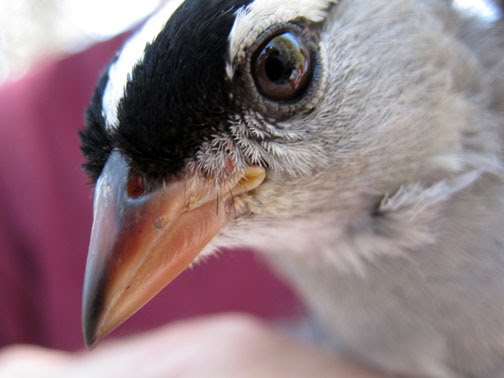
The Black-backed Woodpecker (BBWO) is a threatened bird that colonizes burned areas, and depends on standing dead snags for their nests. As such, they are a touchstone species in the debate about salvage logging of burned and beetle-killed forests. Some environmentalists (notably, Chad Hansen of the John Muir Institute) are advocating for allowing large wildfires to burn, assuming this creates more habitat for the BBWO.
"Our expectation, grounded in island biogeographical theory (MacArthur & Wilson, 1967), was that larger fires should show increased colonization and persistence. To the contrary, sites in larger fires were less likely to be colonized..."
So much for the emerging "Just Let it Burn" argument--these fires are
just too big and destructive. We need to thin first, then let regular,
low intensity fire back in. And leave lots of standing dead for BBWOs and other wildlife, too, of course.
Here's a short video of a BBWO nesting near the Sagehen fishhouse in 2014. BBWOs are a regular resident at Sagehen, where they nest in standing beetle-killed trees, not burned ones. See observations of BBWOs at Sagehen on iNaturalist:
As a follow-up to a recent visit to Washington DC, Sagehen Creek Field Station and the UC Berkeley Office of Government Affairs hosted a "Sagehen Forest Project" Congressional briefing at the station on August 25, 2015. The guests were California and Nevada staffers from the offices of Senators Feinstein, Boxer, Reid and Heller, Representatives McClintock, Amodei and LaMalfa, and Assemblyman Dahle.
A broad spectrum of Sagehen Forest Project partners and others attended, including local and regional Forest Service representatives from both the management and the research sides, Sierra Forest Legacy, Sierra Pacific Industries, National Forest Foundation, Sierra Nevada Conservancy, Truckee River Watershed Council, Lahontan Regional Water Quality Control Board, Lake Tahoe Conservancy, California Forestry Association, Nevada County Board of Supervisors, Washoe County Air Quality Management Division, Center for Art + Environment - Nevada Museum of Art, US Geological Survey, Harrison Studio, the Washoe tribe, CalFire, California Rural Counties, and many others.
The forests of the Sierra Nevada (and the wider American west) are in trouble. Comstock-era clear-cutting, 100 years of fire-suppression in the regrowth, and a drying and warming climate has led to a tenuous situation in which our forests are overstocked and stressed, weakening their resistance to drought, disease, bark-beetle infestation, and wildfire. Before European intervention, regular low intensity fire cycled nutrients, introduced heterogeneity of species and structure, created small openings for wildlife, and cleaned out the duff layer and understory. Now, there is so much fuel built up that when fire does come in it often destroys the entire forest and sterilizes the seed bank. Forests experiencing this kind of fire will often not come back and look like they once did.
We need to remove that built-up fuel, so that low-intensity natural fire can reenter the system. But forest management practices of the past focused heavily on timber yields and fuel reduction, without sufficient attention to restoring ecological functions like wildlife habitat and water supply. This destroyed trust. The result is gridlock, where proposed forestry projects often end up in court.
From environmentalists to loggers, absolutely everyone is concerned about intense and destructive wildfire in our overgrown forests. Over a period of 18-months beginning in 2010, the Sagehen Forest Project partners came together to figure out a way to address everyone's concerns about forest health and management policy.
And we succeeded, creating new prescriptions and tools that are applicable (and being used) on much larger scales than just the Sagehen basin. See Scott Conway's presentation from the meeting to learn more:
Ironically, getting to agreement turned out to be the easy part. Now, with everyone in our community finally agreeing on how we should start managing our forests, there is not enough new biomass processing facility, small material technology, nor mill capacity left in California to provide a destination for the significant amounts of sawlogs and chip that need to come out in order to return to resiliency and ecological balance.
Hopefully, with the help of our State and Congressional representatives, our Federal and State agencies, local NGO's, private interests and citizen partners we can figure out how to move forward with the great forest plan we developed together.
We'll post more info on the project blog as it becomes available, and you can follow and contribute to the conversation on social media under the hashtag: #SagehenForestProject
Event photos from Sherri Eng.
Download PowerPoint presentations from the meeting:
In addition to science done to determine the best treatment options, there is a lot going on in the basin to assess pre- and post-treatment conditions going forward into the manipulation phase of the larger project.
The idea of these studies is to actually monitor and evaluate the effects of the forest restructuring on wildlife, water quality, vegetation and people.
VEGETATION AND FUELS:the SPLAT project and Vaillant thesis gathered a massive dataset, including fuels and vegetation surveys, LiDAR imaging of the basin with and without vegetation, fire model runs, fire history, etc.
BIRDS: Researcher Marty Raphael is revisiting bird survey plots begun in the 1960's within the Donner Burn study transects. The Forest Service monitors bird presence in the basin. Goshawk and Spotted Owl surveys occur annually. The Monitoring Avian Productivity and Survivorship (MAPS) project runs annual banding stations at sites within the Sagehen basin. Vladimir Pravosudov's multi-decade chickadee memory research continues.
FISH SURVEYS: annual fish monitoring continues in various Sagehen Creek stretches.
AMERICAN MARTEN: monitoring of this indicator species was recently revisited in anticipation of the treatments.
HYDROLOGY: the USGS regularly samples Sagehen Creek stream water chemistry and remotely monitors flow through their Hydrologic Benchmark Network. Numerous modeling efforts continue. Terry Hogue is evaluating stream water yield. The Forest Service does annual stream condition surveys. Researcher Jim Kirchner is evaluating weather, groundwater and sap flow patterns.
METEOROLOGY: National Atmospheric Deposition Program precipitation sampling is ongoing. Weather data is continuously collected at 12 towers within the basin.
Scientific Illustrator Stephanie Rozzo recently produced graphic art demonstrating concepts behind the Sagehen Forest Project. Let us know if you would like copies of this poster or its components for project outreach.
The Sagehen Forest Project from F. Felix on Vimeo.
Jeff Brown, Malcolm North & Scott Conway talk to Maia Schneider about the Sagehen Forest Project underway in the Sagehen Experimental Forest.
August 7, 2008: For Sagehen Speaker Series #22, researcher Katie Moriarty discusses her work on American martens in the Sagehen basin. She also discusses other Sierran predators, including the big surprise that turned up on her camera trap on February 28, 2008.
On Wednesday, May 12, 2010, a group of interested stakeholders met to talk about the possibility of collaborating on forest health treatments for the Sagehen basin.
In this introductory meeting, the Tahoe National Forest, Pacific Southwest Research Station & UC Berkeley Sagehen Creek Field Station shared the work they've done to date to define the problem & the likely areas to be affected. Scott Conway, Scott Dailey & Kris Boatner presented for the Forest Service, Jeff Brown for Sagehen Creek Field Station. The panel discussion included Tom Quinn, Forest Supervisor; Joanne Roubique, District Ranger; Peter Stine, PSW; Bill Zielinsky, PSW; & others.
After the presentations at the Tahoe Forest office, the group visited Sagehen for a field trip to examine some of the issues, somewhat constrained by snowy roads.
Later meetings will focus discussion on what actual treatments [or not] will be best for each area. The next meeting date is currently being worked out on Doodle.
The Sagehen basin and adjacent areas have been the focus of pine marten research since the 1970's, making the marten an indicator for monitoring changes to the basin forest.
The following are some theses resulting from this long-term research:
The article tells the story of the discovery of the wolverine during her American marten survey, as well as the fascinating methods used to confirm the animal's species, gender, population source, and personal range.