Sagehen is working hard to scale up the kind of forest treatments needed to return low intensity fire and restore health and resilience to our precious central Sierra forests.
But we can't move forward--and could never have gotten anywhere in the first place--without a broad and increasing range of excellent partners. We need a fundamental shift in our cultural relationship to fire and forestry, and to get there will involve 5 prongs: Art, Business, Policy, Management, and Science. In particular, art is how you change culture, so we need an artistic response at the scale of the management response.
Joining with the Nevada County Arts Council, Arts & Culture Eldorado, the Nevada Museum of Art - Center for Art + Environment and many socially-engaged artists and other supporters, we have initiated an effort called Future Forests. See the website to learn more about us, see what's already happening, and to get involved if our work meshes with yours. We always need more partners!
Listen to Jeff describe the pieces of the puzzle on WeatherBrains 724 (watch from 38:05-44:09):
After all these years, we may have actually slain this dragon: congratulations everyone!
FOR IMMEDIATE RELEASE:
Contact: Governor's Press Office
Thursday, August 13, 2020
(916) 445-4571
California, U.S. Forest Service Establish Shared Long-Term Strategy to Manage Forests and Rangelands
Agreement will improve coordination to reduce wildfire risks on federal and state lands
Funding included in the federal Great American Outdoors Act
Agreement comes as Lake Fire burns in Angeles National Forest
SACRAMENTO
-- In a key step to improve stewardship of California’s forests, the
Newsom Administration and the U.S. Forest Service today announced a new
joint state-federal initiative to reduce wildfire risks, restore
watersheds, protect habitat and biological diversity, and help the state
meet its climate objectives.
The Agreement for Shared Stewardship of California’s Forest and Rangelands
includes a commitment by the federal government to match California’s
goal of reducing wildfire risks on 500,000 acres of forest land per
year. To protect public safety and ecology, experts agree that at least
one million acres of California forest and wildlands must be treated
annually across jurisdictions.
A
historical transition toward unnaturally dense forests, a century of
fire suppression and climate change resulting in warmer, hotter and
drier conditions have left the majority of California’s forestland
highly vulnerable to catastrophic wildfire and in need of active,
science-based management. Since the federal government owns nearly 58
percent of California’s 33 million acres of forestlands, while the state
owns 3 percent, joint state-federal management is crucial to
California’s overall forest health and wildfire resilience.
Improved
coordination also is key since nearly half of the state dollars
invested in fuels management in recent years was spent on federal
land.
“Wildfires
don’t stop at jurisdictional boundaries. As we respond to wildfires in
real-time this summer, improving coordination between the major stewards
of California’s forested land will help us protect communities and
restore forest health across California,” Governor Gavin Newsom said.
“We are grateful to secure the U.S. Forest Service’s commitment to help
us more effectively address the scale of California’s current wildfire
crisis.”
“Collaboration
between state and federal agencies on issues of forest health and
resiliency is critical,” said U.S. Forest Service Chief Vicki
Christiansen. “The Forest Service is fortunate to collaborate on
restoration projects across the state and share science and research to
address issues to help care for the land and serve people. We are
excited to expand our partnership with California to enhance our
collaboration though this Shared Stewardship agreement with California.”
The
Shared Stewardship Agreement builds on existing coordination between
state and federal agencies, and outlines six core principles and nine
specific actions that will drive improved state-federal collaboration:
Prioritize public safety;
Use science to guide forest management;
Coordinate land management across jurisdictions;
Increase the scale and pace of forest management projects;
Remove barriers that slow project approvals; and
Work closely with all stakeholders, including tribal communities, environmental groups, academia and timber companies.
Specifically, through this agreement California and the U.S. Forest Service commit to execute the following activities together:
Treat
one million acres of forest and wildland annually to reduce risk of
catastrophic wildfire (building on the state’s existing 500,000-acre
annual commitment);
Develop a shared 20-year plan for forest health and vegetation treatment that establishes and coordinates priority projects;
Expand use of ecologically sustainable techniques for vegetation treatments such as prescribed fire;
Increase
pace and scale of forest management by improving ecologically
sustainable timber harvest in California and grow jobs by tackling
structural obstacles, such as workforce and equipment shortfalls and
lack of access to capital;
Prioritize
co-benefits of forest health such as carbon sequestration,
biodiversity, healthy watersheds and stable rural economies;
Recycle forest byproducts to avoid burning slash piles;
Improve sustainable recreation opportunities;
Enable resilient, fire-adapted communities; and
Share data and continue to invest in science.
The
Great American Outdoors Act, signed by President Trump on August 4,
will provide critical funding for the Forest Service’s work in
California.
###
Governor Gavin Newsom State Capitol Building Sacramento, CA 95814
There are a lot of other groups working on California forest issues like we are. Here's a growing list:
Alpine Biomass Committee. Unifying partners to promote forest and watershed health, and local economic development.
Forest Service Employees for Environmental Ethics. Our mission is to protect national forests and to reform the U.S. Forest Service by advocating environmental ethics, educating citizens, and defending whistleblowers.
North American Forest Partnership.
We are a diverse community of forest stewards responsible for shaping
the future of North America’s forests. We value the renewable products
and benefits they provide us and are committed to making choices that
keep forests as forests.
The Sagehen Forest Project is growing. The techniques and strategies we developed are being applied at larger scales in California. We are involved in several new initiatives, profiled in previous posts: Lake Tahoe West, Tahoe Central Sierra Initiative, Living Forests.
We continue our outreach efforts. In September, Sagehen hosted 35 insurance industry executives to talk about what they should know about forest management, and how they can help. We are planning our next state and federal legislative training session for 2018. This fall we attended Burning Man as a guest of one of the founders in order to explore how Black Rock City's unconventional thinkers can help. We are meeting with this year's Temple architect and other artists about dead trees, forest health, and how their projects can connect people to forest issues.
Full implementation will take up to 3 more years to get burn windows, but you may want to start following some or all of these other efforts.
"The Tahoe-Central Sierra Initiative (TCSI), a part of the Sierra Nevada Watershed Improvement Program (WIP), brings together innovative approaches to increase the pace and scale of restoration work that gets done across the watersheds of the Central Sierra Nevada and Lake Tahoe areas."
TCSI is another recent initiative that scales up some of the principles of the Sagehen Forest Project. Sagehen is actively involved in the TCSI process, which covers 4.4m-acres in central California and Nevada.
Modeled on the Sagehen Forest Project's successful collaboration:
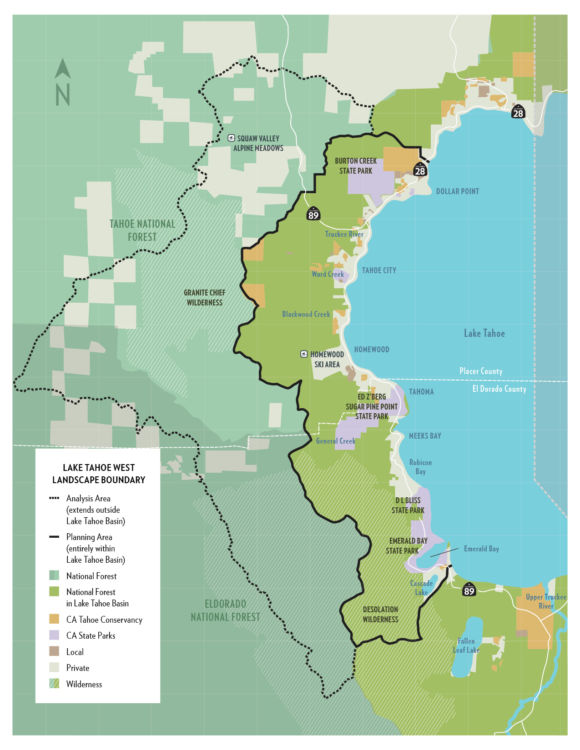
"The goal of the Lake Tahoe West Restoration Partnership (Lake Tahoe West) -- a new interagency initiative of the California Tahoe Conservancy, U.S. Forest Service Lake Tahoe Basin Management Unit, California State Parks, Tahoe Regional Planning Agency, Tahoe Fire and Fuels Team, and National Forest Foundation -- is to restore the resilience of the west shore's forests, watersheds, recreational opportunities, and communities to such threats. The planning area includes 59,013 acres of federal, state, local, and private lands, from Emerald Bay to Squaw Valley."
Saving The West (now Living Forests) continues to move forward with its goal of creating a small wood industry to restore ecological function to western forests. Some recent developments include:
The Center for the Study of the Force Majeure was recruited this fall to submit a $100-million STW grant proposal to the MacArthur Foundation's 100&Change program. The proposal passed administrative review, and the foundation will announce semi-finalists in mid-January. Newton Harrison is also in conversation with the Buckminster Fuller Institute about STW; in 2014, the organization awarded a Fuller Challenge honorable mention to the Harrison's art project at Sagehen.
We are applying for grants to fund a LiDAR and Landsat analysis to determine the quantity and quality of woody material that would be removed should the STW demonstration area in central CA and western NV be treated to restore ecological function. This analysis applies the "8-Emphasis-Area" approach developed in the Sagehen Forest Project collaboration. Quantifying the available supply over the time spans required for investment capital repayment is traditionally the major stumbling block to moving forward with new markets. Due to the realities of implementation cost, the Forest Service currently designs projects around what they can sell on the current commodities market, which is not useful for making financial projections.
The Sagehen Forest Project model is now being implemented in the Lake Tahoe West Shore collaborative project, a big scaling up of the concepts.
We continue meeting with all kinds of people already working at the intersection of industry and forest management in CA and NV, creating synergies and opportunities. One interesting idea we are discussing with the Burning Man people is the use of Sagehen Project slash for the construction of structures like the Man or the Temple, as a way to spread these concepts to a global audience.
Meeting in the field on June 30, 2016 to view the current forestry work, 34 attendees representing 18 different organizations visited Sagehen to check in on the Sagehen Forest Project implementation. The group included the contractor, project funders, and members of the collaborative design process, as well as organizations and individuals involved in the upcoming Lake Tahoe west shore collaborative project:
UC Berkeley, Sagehen Creek Field Station
Truckee Ranger District, Tahoe NF, USFS
Tahoe National Forest
National Forest Foundation (NFF)
Sierra Nevada Conservancy, CA (SNC)
Wildife Conservation Board, CA (WCB)
Sierra Business Council (SBC)
Truckee Fire
Cal Fire
South Yuba River Citizens League (SYRCL)
Lake Tahoe Conservancy, CA (CTC)
Tahoe Regional Planning Agency (TRPA)
California State Parks
Lake Tahoe Basin Management Unit, USFS
Private citizens
West Forest Inc.
Pacific Southwest Research Station, USFS
USFS Region 5
While mastication is certainly traumatic, everyone seemed pleased with the overall results so far, and eager to see fire on the ground. KGO-TV--the San Francisco Bay ABC affiliate--sent a reporter, and I'll post that piece when it is released.
Adrian Harpold, Ph.D., Nevada Mountain Ecohydrology Group, University of Nevada, Reno prepared this one-sheet to explain his work at Sagehen, titled "More Water and Healthy Forests? Improved Forest Management By Integrating LiDAR Remote
Sensing and Hyper-Resolution Models".
The Sagehen Forest Project has spun off several remarkable related projects.
Saving The West (STW), now Living Forests, is a policy document developed by the Center for the Study of the Force Majeure at UC Santa Cruz, including artist Newton Harrison and consultant Josh Harrison. STW is being developed as a rallying point to bring together a group of folks interested in addressing the glaring hole in the Sagehen Forest Project: the lack of a California market for raw wood product.
Going into the collaborative process, we all thought that getting environmentalists and loggers to agree would be the hard part. But, given a little time, that turned out to be relatively easy: everyone benefits from a healthy forest. Yet, now that we all agree on what needs to be done, we are stymied by the lack of someone to buy even the saw logs coming off the forest, much less the wood chip and small diameter wood. For the unit treatments around the station which are being funded by the National Forest Foundation (NFF) grant, we are just masticating everything into chip that will be burned on the ground. Or chopping and stacking logs into burn piles. This seems so wasteful: that material should be used, and continue to act as carbon storage.
The Center is working to put forestry issues onto the platform of the Democratic presidential nominee, as well as into the Governor's office. If these politicians start to hear about this need from both the scientists and the artists, it carries more weight and importance.
We have begun to bring Cathexis Architecture into the conversation. Cathexis has an impressive redevelopment project planned for a sizable chunk of downton Reno, NV, and they would like to build at least one wooden skyscraper. Binderholz, an Austrian company that manufactures engineered wood products, is planning to open a plant in the US. They are looking in the Pacific Northwest, but the NFF is reaching out to try to connect them with the Reno Dept. of Economic Development. If we could develop a market for wood product here, that reduces transportation costs to get material out of the forest.
As a follow-up to a recent visit to Washington DC, Sagehen Creek Field Station and the UC Berkeley Office of Government Affairs hosted a "Sagehen Forest Project" Congressional briefing at the station on August 25, 2015. The guests were California and Nevada staffers from the offices of Senators Feinstein, Boxer, Reid and Heller, Representatives McClintock, Amodei and LaMalfa, and Assemblyman Dahle.
A broad spectrum of Sagehen Forest Project partners and others attended, including local and regional Forest Service representatives from both the management and the research sides, Sierra Forest Legacy, Sierra Pacific Industries, National Forest Foundation, Sierra Nevada Conservancy, Truckee River Watershed Council, Lahontan Regional Water Quality Control Board, Lake Tahoe Conservancy, California Forestry Association, Nevada County Board of Supervisors, Washoe County Air Quality Management Division, Center for Art + Environment - Nevada Museum of Art, US Geological Survey, Harrison Studio, the Washoe tribe, CalFire, California Rural Counties, and many others.
The forests of the Sierra Nevada (and the wider American west) are in trouble. Comstock-era clear-cutting, 100 years of fire-suppression in the regrowth, and a drying and warming climate has led to a tenuous situation in which our forests are overstocked and stressed, weakening their resistance to drought, disease, bark-beetle infestation, and wildfire. Before European intervention, regular low intensity fire cycled nutrients, introduced heterogeneity of species and structure, created small openings for wildlife, and cleaned out the duff layer and understory. Now, there is so much fuel built up that when fire does come in it often destroys the entire forest and sterilizes the seed bank. Forests experiencing this kind of fire will often not come back and look like they once did.
We need to remove that built-up fuel, so that low-intensity natural fire can reenter the system. But forest management practices of the past focused heavily on timber yields and fuel reduction, without sufficient attention to restoring ecological functions like wildlife habitat and water supply. This destroyed trust. The result is gridlock, where proposed forestry projects often end up in court.
From environmentalists to loggers, absolutely everyone is concerned about intense and destructive wildfire in our overgrown forests. Over a period of 18-months beginning in 2010, the Sagehen Forest Project partners came together to figure out a way to address everyone's concerns about forest health and management policy.
And we succeeded, creating new prescriptions and tools that are applicable (and being used) on much larger scales than just the Sagehen basin. See Scott Conway's presentation from the meeting to learn more:
Ironically, getting to agreement turned out to be the easy part. Now, with everyone in our community finally agreeing on how we should start managing our forests, there is not enough new biomass processing facility, small material technology, nor mill capacity left in California to provide a destination for the significant amounts of sawlogs and chip that need to come out in order to return to resiliency and ecological balance.
Hopefully, with the help of our State and Congressional representatives, our Federal and State agencies, local NGO's, private interests and citizen partners we can figure out how to move forward with the great forest plan we developed together.
We'll post more info on the project blog as it becomes available, and you can follow and contribute to the conversation on social media under the hashtag: #SagehenForestProject
Event photos from Sherri Eng.
Download PowerPoint presentations from the meeting:
Jeff and I were just in Washington, DC with the Organization of Biological Field Stations (OBFS) to share information about field stations with Congressional staffers. One of the topics Jeff and I spent a lot of time discussing with our state reps is the Sagehen Forest Project.
One big issue is how project implementation is being held up by the lack of a market for our logs, since there is so much black timber from recent fires.
As a society, we are unintentionally sacrificing the living in order to scavenge the dead. Not good!
8-22-14: Mastication begins in the Donner Fire plantations.
10-years of study and planning are finally reaching implementation!
And here's some more great project news from the National Forest Foundation:
"Folks,
We were successful in securing funding for 7 projects on the Truckee River Treasured Landscapes site from Wildlife Conservation Board. WCB awarded $775,100 to implement the following restoration projects: Prosser fish habitat restoration, Outback watershed restoration, Jammer Chair stream & aspen restoration, Sagehen Creek fen restoration, Phoenix watershed improvements, Johnson Canyon restoration and Sagehen Sensitive Species Restoration. The Little Truckee River fish habitat project that was originally included in the proposal had to be delayed to November due a board member conflict of interest and subsequent lack of quorum to approve it but we expect to receive $188,800 for that project later this year. For the recently approved projects NFF, USFS, Truckee River Watershed Council and Sierra Nevada Conservancy contributed an additional $1.9 mn to implementation. WCB BOD members praised the project for its scale and cooperation among such a diversity of partners.
I’d like to thank Kim Boyd of the Tahoe RCD for being especially gracious to be the lead agency on the CEQA work that we had to complete in rapid order as well as the Forest Service and all the partners that made this grant successful. Hopefully there is much more to come. Nice job all!
I am very pleased to let you all know that the Tahoe National Forest was able to award our first contract implementing the decisions made for the Sagehen Project. This is a wonderful and exciting step. Everyone who participated has helped us get to this point. We are also very pleased to announce that on March 12, 2014, the National Forest Foundation was awarded a $349,140 grant by the Sierra Nevada Conservancy that will allow implementation of the next phase of this project, as well.
I need to say that I am very proud of everyone who helped us get here. This was truly a meeting of the minds. We started with a variety of ideas and through a great deal of good, hard work, came to an amazing place. Everyone brought their passion but then took time to hear and understand everyone else. I know there are still some different viewpoints, but this project is so much better today for the energy and effort that everyone put into the understanding that has developed. Thank you!
I need to say as proud as I am of everyone who participated, that I am particularly proud of the core team who put in so many hours and worked so hard to be sure we captured all the ideas and found ways to fit them together, who read and re-read the science until it could be incorporated into the design, who helped us craft a great project and then helped us explain it in the NEPA document.
I know that the implementation is our next opportunity and challenge but I welcome it and hope you do as well. We have learned so much getting to this point, but I know that learning will continue. Jeff Brown has told me so many times to get on with the implementation so the next group of scientists can watch us work, see the results and help us learn more. Well, here we go….
The legal notice of the decision is expected to be published in Grass Valley’s The Union newspaper as soon as tomorrow. The date of the legal notice in The Union will establish the timeframe for the 45-day appeal filing period under 36 CFR 215.
Laurie Perrot
Environmental Coordinator
Tahoe National Forest
631 Coyote Street
Nevada City, CA 95959
lperrot@fs.fed.us
(530) 478-6244
In addition to science done to determine the best treatment options, there is a lot going on in the basin to assess pre- and post-treatment conditions going forward into the manipulation phase of the larger project.
The idea of these studies is to actually monitor and evaluate the effects of the forest restructuring on wildlife, water quality, vegetation and people.
VEGETATION AND FUELS:the SPLAT project and Vaillant thesis gathered a massive dataset, including fuels and vegetation surveys, LiDAR imaging of the basin with and without vegetation, fire model runs, fire history, etc.
BIRDS: Researcher Marty Raphael is revisiting bird survey plots begun in the 1960's within the Donner Burn study transects. The Forest Service monitors bird presence in the basin. Goshawk and Spotted Owl surveys occur annually. The Monitoring Avian Productivity and Survivorship (MAPS) project runs annual banding stations at sites within the Sagehen basin. Vladimir Pravosudov's multi-decade chickadee memory research continues.
FISH SURVEYS: annual fish monitoring continues in various Sagehen Creek stretches.
AMERICAN MARTEN: monitoring of this indicator species was recently revisited in anticipation of the treatments.
HYDROLOGY: the USGS regularly samples Sagehen Creek stream water chemistry and remotely monitors flow through their Hydrologic Benchmark Network. Numerous modeling efforts continue. Terry Hogue is evaluating stream water yield. The Forest Service does annual stream condition surveys. Researcher Jim Kirchner is evaluating weather, groundwater and sap flow patterns.
METEOROLOGY: National Atmospheric Deposition Program precipitation sampling is ongoing. Weather data is continuously collected at 12 towers within the basin.
First was a meet-and-greet with our PSW liaison Rick Bottoms, Truckee District Ranger Joanne Roubique, and the new Deputy Regional Forester, Barney Gyant. It was great to meet and get a chance to catch Barney up on Sagehen plans and projects. We're definitely on the same page and we look forward to working with him in the future!
Next on the agenda was a tour of the lower Sagehen Forest project demo plot with Joanne and her Vegetation Management Officer, Scott Conway; the National Forest Foundation's California Program Director, Vance Russell; and the Lake Tahoe Basin Management Unit's Deputy Forest Supervisor Jeff Marsolais and Vegetation Management Officer, Rita Mustatia.
The meetings overlap!
Discussion of the treatment strategy and the process.
Scott, Joanne and Jeff discussed the treatment design and the collaborative process behind the Sagehen Forest Project. Jeff and Rita talked about the challenges in the Lake Tahoe basin, some of their plans for fire mitigation and forest health, and how the SFP might fit into those plans.
We're very excited about the wider scope possibilities of the SFP!