Modeled on the Sagehen Forest Project's successful collaboration:
"The goal of the Lake Tahoe West Restoration Partnership (Lake Tahoe West) -- a new interagency initiative of the California Tahoe Conservancy, U.S. Forest Service Lake Tahoe Basin Management Unit, California State Parks, Tahoe Regional Planning Agency, Tahoe Fire and Fuels Team, and National Forest Foundation -- is to restore the resilience of the west shore's forests, watersheds, recreational opportunities, and communities to such threats. The planning area includes 59,013 acres of federal, state, local, and private lands, from Emerald Bay to Squaw Valley."
Cross-laminated timber (CLT) is a structural wood product that can be made from small diameter timber. This makes it a strong candidate for industrial use of some of the low-value wood product that needs to come off the Tahoe forests in order to restore ecological function and resilience to these damaged systems. As a bonus, CLT reduces the massive carbon footprint of concrete and steel in urban buildings.
Though very strong, fire- and seismic-resistant, CLT is not in the Universal Building Code...yet:
WoodWorks, in cooperation with the United States Forest Service and the Softwood Lumber Board, conducted a series of live blast tests on three cross-laminated timber (CLT) structures at Tyndall Air Force Base. All structures remained intact and matched modeling predications with acceptable levels of damage under significant explosive loading. WoodWorks will release a full analysis of testing results when available. The results will be used to further expand the use of wood solutions for Department of Defense applications and other blast-resistant construction.
Check out that shockwave! Read more about these tests on the WoodWorks website.
Saving The West (now Living Forests) continues to move forward with its goal of creating a small wood industry to restore ecological function to western forests. Some recent developments include:
The Center for the Study of the Force Majeure was recruited this fall to submit a $100-million STW grant proposal to the MacArthur Foundation's 100&Change program. The proposal passed administrative review, and the foundation will announce semi-finalists in mid-January. Newton Harrison is also in conversation with the Buckminster Fuller Institute about STW; in 2014, the organization awarded a Fuller Challenge honorable mention to the Harrison's art project at Sagehen.
We are applying for grants to fund a LiDAR and Landsat analysis to determine the quantity and quality of woody material that would be removed should the STW demonstration area in central CA and western NV be treated to restore ecological function. This analysis applies the "8-Emphasis-Area" approach developed in the Sagehen Forest Project collaboration. Quantifying the available supply over the time spans required for investment capital repayment is traditionally the major stumbling block to moving forward with new markets. Due to the realities of implementation cost, the Forest Service currently designs projects around what they can sell on the current commodities market, which is not useful for making financial projections.
The Sagehen Forest Project model is now being implemented in the Lake Tahoe West Shore collaborative project, a big scaling up of the concepts.
We continue meeting with all kinds of people already working at the intersection of industry and forest management in CA and NV, creating synergies and opportunities. One interesting idea we are discussing with the Burning Man people is the use of Sagehen Project slash for the construction of structures like the Man or the Temple, as a way to spread these concepts to a global audience.
Meeting in the field on June 30, 2016 to view the current forestry work, 34 attendees representing 18 different organizations visited Sagehen to check in on the Sagehen Forest Project implementation. The group included the contractor, project funders, and members of the collaborative design process, as well as organizations and individuals involved in the upcoming Lake Tahoe west shore collaborative project:
UC Berkeley, Sagehen Creek Field Station
Truckee Ranger District, Tahoe NF, USFS
Tahoe National Forest
National Forest Foundation (NFF)
Sierra Nevada Conservancy, CA (SNC)
Wildife Conservation Board, CA (WCB)
Sierra Business Council (SBC)
Truckee Fire
Cal Fire
South Yuba River Citizens League (SYRCL)
Lake Tahoe Conservancy, CA (CTC)
Tahoe Regional Planning Agency (TRPA)
California State Parks
Lake Tahoe Basin Management Unit, USFS
Private citizens
West Forest Inc.
Pacific Southwest Research Station, USFS
USFS Region 5
While mastication is certainly traumatic, everyone seemed pleased with the overall results so far, and eager to see fire on the ground. KGO-TV--the San Francisco Bay ABC affiliate--sent a reporter, and I'll post that piece when it is released.
Adrian Harpold, Ph.D., Nevada Mountain Ecohydrology Group, University of Nevada, Reno prepared this one-sheet to explain his work at Sagehen, titled "More Water and Healthy Forests? Improved Forest Management By Integrating LiDAR Remote
Sensing and Hyper-Resolution Models".
The Sagehen Forest Project has spun off several remarkable related projects.
Saving The West (STW), now Living Forests, is a policy document developed by the Center for the Study of the Force Majeure at UC Santa Cruz, including artist Newton Harrison and consultant Josh Harrison. STW is being developed as a rallying point to bring together a group of folks interested in addressing the glaring hole in the Sagehen Forest Project: the lack of a California market for raw wood product.
Going into the collaborative process, we all thought that getting environmentalists and loggers to agree would be the hard part. But, given a little time, that turned out to be relatively easy: everyone benefits from a healthy forest. Yet, now that we all agree on what needs to be done, we are stymied by the lack of someone to buy even the saw logs coming off the forest, much less the wood chip and small diameter wood. For the unit treatments around the station which are being funded by the National Forest Foundation (NFF) grant, we are just masticating everything into chip that will be burned on the ground. Or chopping and stacking logs into burn piles. This seems so wasteful: that material should be used, and continue to act as carbon storage.
The Center is working to put forestry issues onto the platform of the Democratic presidential nominee, as well as into the Governor's office. If these politicians start to hear about this need from both the scientists and the artists, it carries more weight and importance.
We have begun to bring Cathexis Architecture into the conversation. Cathexis has an impressive redevelopment project planned for a sizable chunk of downton Reno, NV, and they would like to build at least one wooden skyscraper. Binderholz, an Austrian company that manufactures engineered wood products, is planning to open a plant in the US. They are looking in the Pacific Northwest, but the NFF is reaching out to try to connect them with the Reno Dept. of Economic Development. If we could develop a market for wood product here, that reduces transportation costs to get material out of the forest.
The contract to treat the UC Berkeley-managed units around the field station has been executed! West Forest, Inc. brought their masticators out last Thursday morning, just in time for this weekend's snow, which has shut work down again until the ground dries out. Next week, we expect the hand-thinning to begin, as well.
The work done before the weather shut-down is dramatic! It's easy to see how this project will help restore ecological function: reduce stress on the big trees, reduce fire danger, and create more wildlife habitat.
The Sagehen Forest Project proposes restoring ecological function to the Sagehen Basin. It turns out that doing this tames wildfire and is good for wildlife, good for the timber industry, and good for water quality. Everyone wins.
Some recent developments suggest that forest management policy in California may be about to shift dramatically in that direction.
"The California Department of Forestry and Fire Protection (CAL FIRE) requests $180 million
Greenhouse Gas Reduction Fund (GGRF) in Fiscal Year (FY) 2016-17, with position authority and
associated funding in subsequent years through FY 2021-22...for a comprehensive
forest health program that will further secure forest carbon and reduce greenhouse gas (GHG)
emissions to meet the 2030 carbon goals within Executive Crder (EC) B-30-15. Funds will support the
expansion of the Urban and Community Forestry, Forest Legacy Programs , and target landscape-scale
Forest Health projects in high-priority forested upper watersheds in coordination with the Department of
Fish and Wildlife, to realize the largest direct benefit for GHG reduction, forest resilience and cobenefits,
such as protection of water, wildlife habitat, and rural economic stability."
2. Saving The West(now Living Forests). A policy Discussion Document from the Center for the Study of the Force Majeure, 2016.
"Just released PPIC report urges 5 reforms needed for water in California including restoring forest health and reducing fuel loads in headwaters. Also calls for FS to shift focus from fire suppression to fire prevention. The specific recommendation is:"
Initiate multiple large-scale collaborative projects to restore forest health
There has been considerable progress in improving the pace of restoration of forested lands nationwide (US Forest Service 2015). Yet many interviewees felt that to date, most efforts at fire prevention and forest health have been small-scale demonstration projects. To improve public perception and demonstrate benefits—including the potential for boosting drought resilience for downstream users—the Forest Service needs to incorporate a series of large-scale projects into all of the emerging forest management plans. These projects should explore incentives for financial investments from beneficiaries to cover a portion of the costs.32 In addition, partnerships should be formed to promote research and development of new wood energy and building industry products that can increase the value of harvests that reduce fuel loads.
As a follow-up to a recent visit to Washington DC, Sagehen Creek Field Station and the UC Berkeley Office of Government Affairs hosted a "Sagehen Forest Project" Congressional briefing at the station on August 25, 2015. The guests were California and Nevada staffers from the offices of Senators Feinstein, Boxer, Reid and Heller, Representatives McClintock, Amodei and LaMalfa, and Assemblyman Dahle.
A broad spectrum of Sagehen Forest Project partners and others attended, including local and regional Forest Service representatives from both the management and the research sides, Sierra Forest Legacy, Sierra Pacific Industries, National Forest Foundation, Sierra Nevada Conservancy, Truckee River Watershed Council, Lahontan Regional Water Quality Control Board, Lake Tahoe Conservancy, California Forestry Association, Nevada County Board of Supervisors, Washoe County Air Quality Management Division, Center for Art + Environment - Nevada Museum of Art, US Geological Survey, Harrison Studio, the Washoe tribe, CalFire, California Rural Counties, and many others.
The forests of the Sierra Nevada (and the wider American west) are in trouble. Comstock-era clear-cutting, 100 years of fire-suppression in the regrowth, and a drying and warming climate has led to a tenuous situation in which our forests are overstocked and stressed, weakening their resistance to drought, disease, bark-beetle infestation, and wildfire. Before European intervention, regular low intensity fire cycled nutrients, introduced heterogeneity of species and structure, created small openings for wildlife, and cleaned out the duff layer and understory. Now, there is so much fuel built up that when fire does come in it often destroys the entire forest and sterilizes the seed bank. Forests experiencing this kind of fire will often not come back and look like they once did.
We need to remove that built-up fuel, so that low-intensity natural fire can reenter the system. But forest management practices of the past focused heavily on timber yields and fuel reduction, without sufficient attention to restoring ecological functions like wildlife habitat and water supply. This destroyed trust. The result is gridlock, where proposed forestry projects often end up in court.
From environmentalists to loggers, absolutely everyone is concerned about intense and destructive wildfire in our overgrown forests. Over a period of 18-months beginning in 2010, the Sagehen Forest Project partners came together to figure out a way to address everyone's concerns about forest health and management policy.
And we succeeded, creating new prescriptions and tools that are applicable (and being used) on much larger scales than just the Sagehen basin. See Scott Conway's presentation from the meeting to learn more:
Ironically, getting to agreement turned out to be the easy part. Now, with everyone in our community finally agreeing on how we should start managing our forests, there is not enough new biomass processing facility, small material technology, nor mill capacity left in California to provide a destination for the significant amounts of sawlogs and chip that need to come out in order to return to resiliency and ecological balance.
Hopefully, with the help of our State and Congressional representatives, our Federal and State agencies, local NGO's, private interests and citizen partners we can figure out how to move forward with the great forest plan we developed together.
We'll post more info on the project blog as it becomes available, and you can follow and contribute to the conversation on social media under the hashtag: #SagehenForestProject
Event photos from Sherri Eng.
Download PowerPoint presentations from the meeting:
There is lots of good information about the Sagehen Forest Project on this blog. But it can be tricky to find a succinct explanation, so I've written a synopsis (below). Printable version here.
Be sure to see the Purpose and Needs statement for a more complete and detailed discussion of the project genesis.
================
The Sagehen Forest Project
The northern Sierra Nevada was largely denuded of timber during the Comstock silver strike in Virginia City, the construction of the transcontinental railroad, and the post WWII construction boom. The forest that re-grew was optimized for timber harvest, and now shows limited diversity of tree species, size and age class, as well as a massive accumulation of fuel due to a century of aggressive fire suppression.
Dense "dog-hair" stand of Lodgpole pine.
These stands choke off resources for large
trees and constitute a big fire danger.
This is not a healthy structure for a forest nor for the things that live in the forest: large fuel loads along with high susceptibility to drought, insect infestation and disease result in devastatingly hot and destructive wild fires and declining wildlife habitat quality. Unfortunately, much of the forested western US suffers from the same conditions. Due to a warming, drying climate since their establishment after the last ice age, forests cannot always recover or reestablish after these disruptive events.
At this point in time, the forests need active manipulation to return them to a more natural, resilient, fire-tolerant structure, but this is too expensive to do everywhere. A strategy for treating a smaller portion of the forest that yields similar benefits was proposed and adopted by the Forest Service in the early 2000’s. The strategy was called SPLATs, Strategically Placed Land Area Treatments. The idea involves thinning and removing fuel from roughly 30% of forested areas in a waffle-like pattern. This approach shifts the choice of treatment zones from smaller, more targeted and logistically or politically motivated areas, to a broader “landscape” management perspective.
A large, ecologically-valuable Jeffrey pine, released by
thinning treatment at Sagehen.
But SPLATs had never been tested on a real forest, nor in areas with topographic relief. In partnership with the Forest Service, Berkeley professors Scott Stephens and John Battles decided to implement the strategy at Sagehen. They funded a Ph.D. student and a massive data collection effort. Creating what is one of the best data sets of its kind, the study sampled the entire basin for vegetation and fuels, including a grid of permanent 500-m2 plots where every tree is tagged and measured, canopy closure determined, and ground fuels classified. LiDAR laser mapping created high-resolution topographic maps at 1-m resolution, for both vegetated and bare-earth surfaces. A rare eastern Sierra fire history dating back to the 1600’s was drawn from live trees and Comstock-era stumps.
Existing remote sensing and fire models were enhanced with this data and new predictive tools created. In this process, it became obvious that while these treatments would definitely disrupt fire behavior, their implementation would potentially impact wildlife, water quality and other forest products. To fill in the missing pieces, the Forest Service’s Pacific Southwest Research Station (PSW) put together an interdisciplinary team to come up with a guiding document: a science synthesis on the broader natural ecology of Sierra east-slope pine forests. The result, General Technical Report (GTR) 220, provided a big picture view of the issue and how to structure forests that are not just fire-resistant, but also topographically diverse, wildlife friendly and responsive to today’s--and tomorrow’s--altered climate conditions.
With this tool in hand, Sagehen worked with the Forest Service to create a collaborative process to decide what to do in the basin forest, where, and how to do it. We invited everyone who might be interested: loggers, environmentalists, agency staff, academics, NGOs, interested citizens. And they came. We hired a facilitator. We created a public outreach blog and posted every document the group created. We treated two demo plots so everyone could see the ideas on the ground rather than just in the abstract. The group spent the last year and a half hammering out a solution that everyone could live with.
And, amazingly, everyone was able to agree. The project was approved without litigation at any stage. Official letters of support came from both the loggers and the environmentalists.
Additionally, the National Forest Foundation has jumped on board, adopting the Truckee River watershed for their “Treasured Landscapes” initiative, and promoting the Sagehen Forest Project as the best way to address forest restoration efforts in the area.
This project potentially offers other forests a way around the logjam of litigation and contentiousness that has shut down many timber management projects proposed on public lands in the western US in recent years. As such, the Lake Tahoe Basin Management Unit has adopted the strategy and worked hard to shift their employees toward this new paradigm. Their public collaboration began in fall 2016 and includes Sagehen. A large forest management project at the Truckee-Airport Board’s Waddle Ranch is also modeled after the Sagehen Forest Project.
The Sagehen Forest Project is creating momentum to revisit past basin research and answer larger questions than this science originally addressed. In addition to resampling the vast forest structure inventory, and in anticipation of the coming changes to the landscape, hydrology and soils data collection expanded this year. And researchers actively re-sampled historic small mammal trapping transects, fish and bird surveys, and pine marten monitoring dating back to the 1960’s. Protected Activity Centers (PACs) set aside for species of concern like Northern Goshawks and California Spotted Owls are being watched carefully to see if the animals really do prefer the current conditions, or if they will move when different local habitat becomes available.
Everyone is happy. We thought we were done. We began implementing the prescription at Sagehen.
But it turns out that the timber industry in California is basically gone. There is very little mill capacity left and what there is, is now unavailable. As a culture, we made a huge misstep that seemed like a good idea at the time: we decided to give away the standing dead timber from catastrophic fire and beetle kill. This dead wood is now plugging up the available capacity: why buy green timber when you can get an unlimited supply of black timber for free? With no market for the wood coming out of the forest, there is no money to fund removing it.
Our culture has essentially decided to sacrifice the living in order to scavenge the dead. And it turns out that there is no valid reason to do this: ecosystem health values that standing dead, and once the needles fall off the beetle kill there is little fire danger left. In fact, removing just the logs from a forest (and leaving the brush, small trees, limbs, needles, bark, etc. as in traditional forestry) only reduces fire risk by 3 or 4%.
What we need now is a new timber industry, one that uses small diameter trees and slash to produce not just conventional timber, but new wood products like engineered timber, cross-laminated timber (CLT), oriented strand board (OSB), torrefied pellets, soil enhancements, bio-energy, and even hydrocarbon feedstock for plastics. A distributed forestry industry creates local jobs. Developing a viable small timber industry as a byproduct of forest health treatments has additional benefits, replacing steel, petroleum and concrete in multi-story structures that are more fire-resistant and seismic safe, while sinking massive amounts of carbon that will otherwise eventually burn up in the forest.
Jeff and I were just in Washington, DC with the Organization of Biological Field Stations (OBFS) to share information about field stations with Congressional staffers. One of the topics Jeff and I spent a lot of time discussing with our state reps is the Sagehen Forest Project.
One big issue is how project implementation is being held up by the lack of a market for our logs, since there is so much black timber from recent fires.
As a society, we are unintentionally sacrificing the living in order to scavenge the dead. Not good!
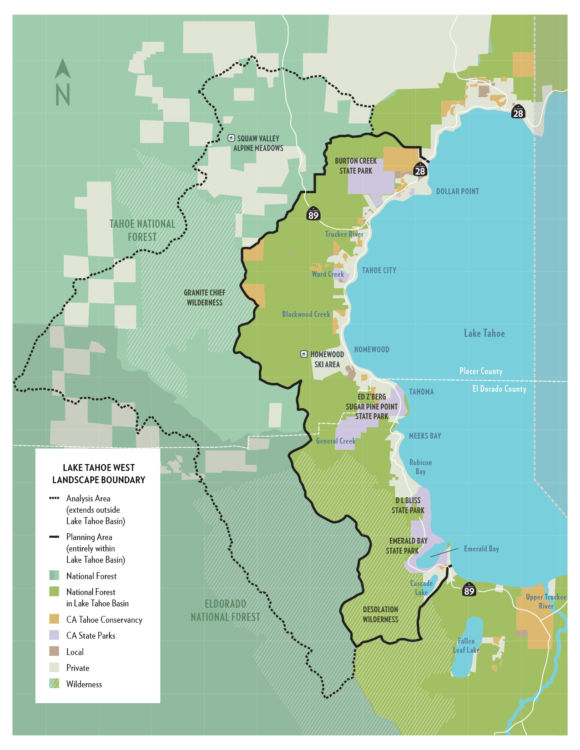 November 30, 2016 was the inaugural meeting of the Lake Tahoe West Restoration Partnership.


